
Rune-stone Hovgårdsstenen eller Håkansstenen, U11, L2017:1363 in Adelsö parish, Ekerö municipality
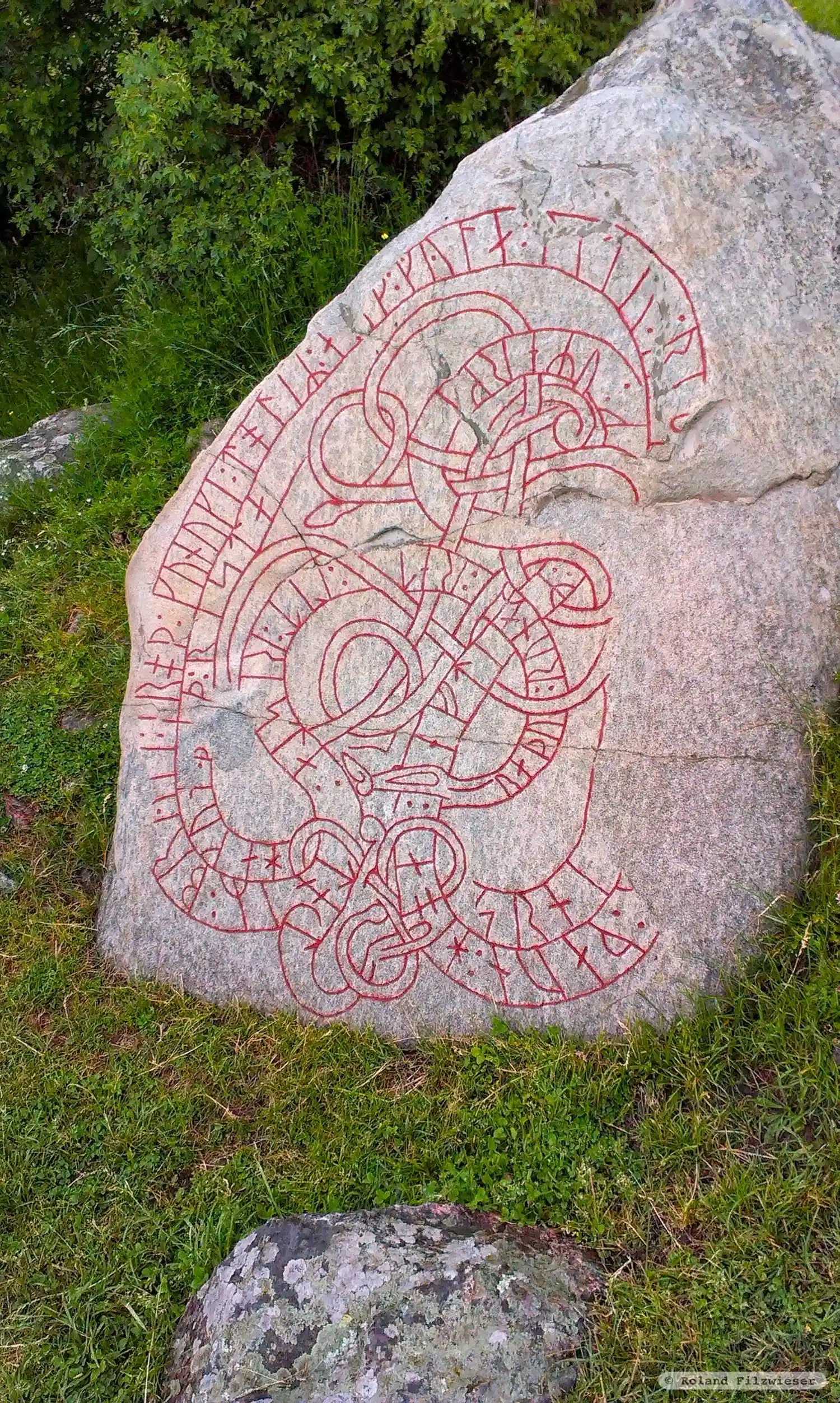
Photo: Roland Filzwieser
Runic inscription
raþ| |þu : runaR : ret : lit : rista : toliR : bry[t]i : i roþ : kunuki : toliR : a(u)k : gyla : litu : ris... ...- : þaun : hion : eftiR ...k : merki srni... haku(n) · (b)aþ : rista
Inscription
raþ| |þu : runaR : ret : lit : rista : toliR : bry[t]i : i roþ : kunuki : toliR : a(u)k : gyla : litu : ris... ...- : þaun : hion : eftiR ...k : merki srni... haku(n) · (b)aþ : rista
Translation
Interpret the runes! Tólir the steward of Roðr had them rightly carved for the King. Tólir and Gylla had [the runes] carved ... this married couple as a landmark in memory of themselves(?) ... Hákon ordered (it) be carved.
Find the carving
Rune-stone Hovgårdsstenen eller Håkansstenen, U11, L2017:1363 in Adelsö parish, Ekerö municipality

Facts
| Monument number | L2017:1363 |
|---|---|
| Swedish National Heritage Board ID | Adelsö 46:1 |
| Carver | Olev (A); Torgöt Fotsarve (A) |
| Status | Confirmed on location |
| Place | Visible above ground |
| Material | Gray granite |
| Period | Viking age |
| Antiquarian assessment | Ancient monument |
| Damage status | Damage |
| County | Stockholm |
| Municipality | Ekerö |
| Parish | Adelsö |
| Coordinates | 59.3601435, 17.5340045 |
Sources
Most of the factual information in Runkartan comes from the Swedish National Heritage Board’s Fornsök data and from the Scandinavian Runic Text Database. The maps come from OpenStreetMap and Leaflet.js. The photographs were taken by the credited photographers.